
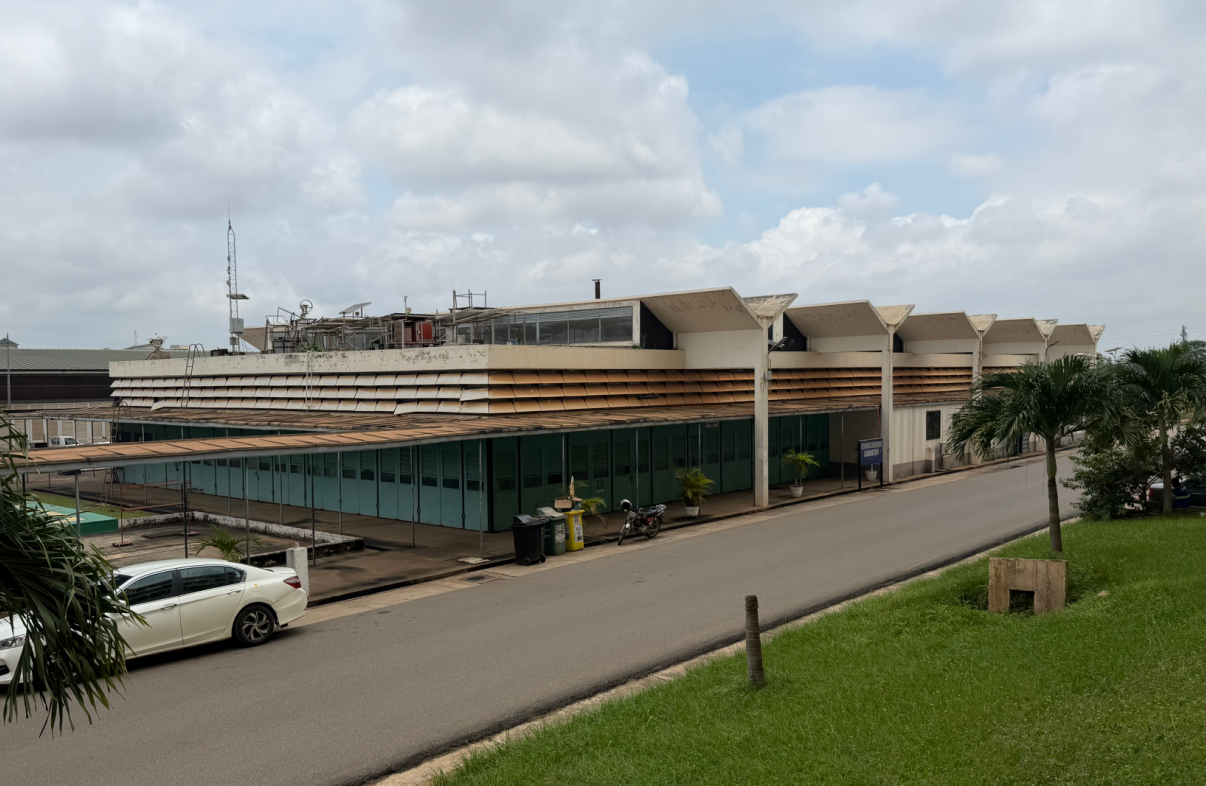
Two photographs. The same building. Seventy-four years apart
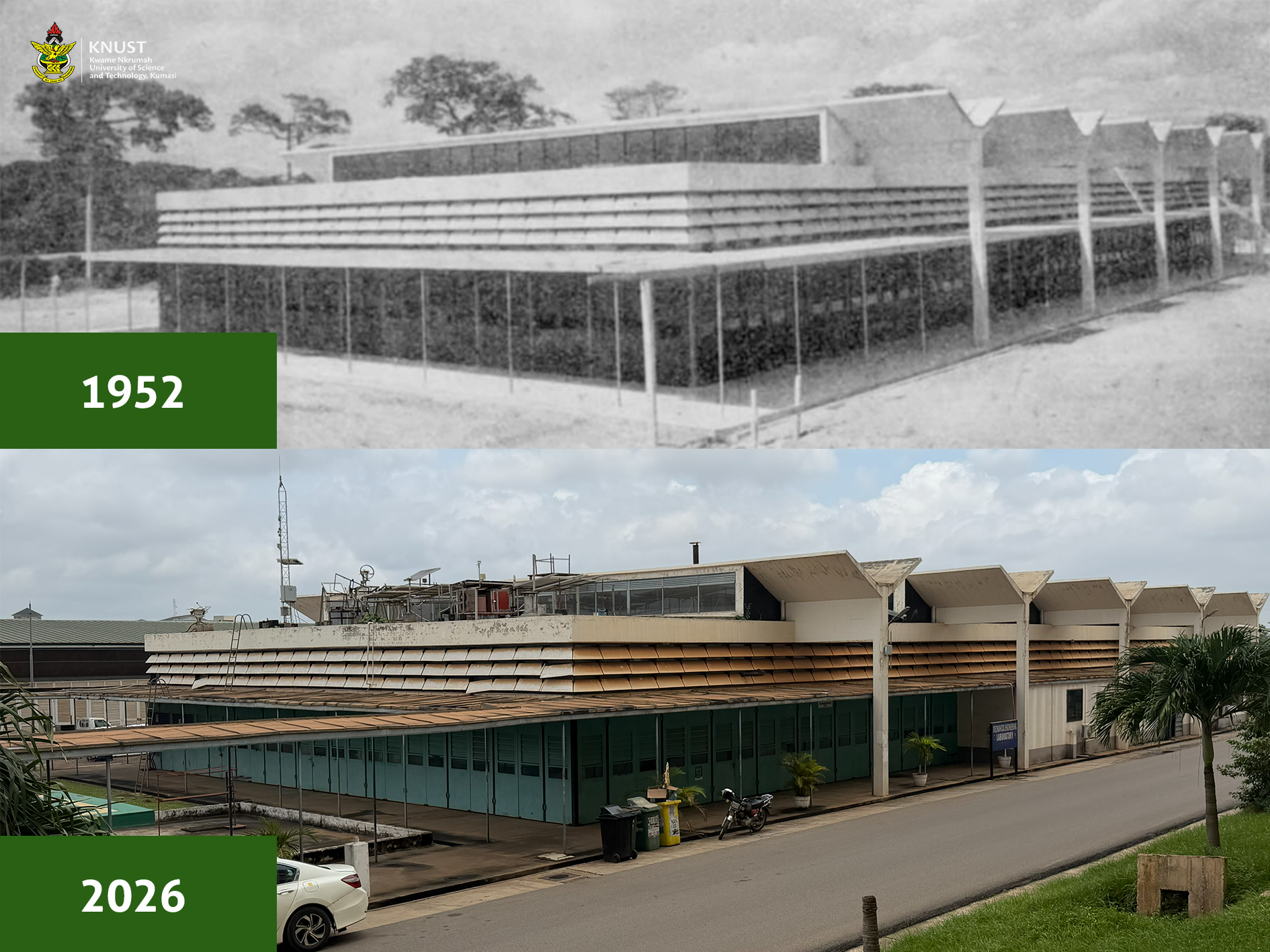
The first photograph, taken in 1952, shows a newly constructed engineering facility at the then Kumasi College of Technology. It was later published in Nature in 1953 with the caption: “The first section of the engineering workshops of the Kumasi College of Technology.”
Today, the building is the Mechanical Engineering Laboratory of the Kwame Nkrumah University of Science and Technology, Kumasi (KNUST).
Placed alongside a photograph taken in 2026, the 1952 image reveals remarkable continuity. Although the surroundings and parts of the structure have changed, its long horizontal façade, projecting roof and distinctive repeated roof forms remain recognisable.
Built at the beginning
The laboratory dates to the formative years of the institution.
The Kumasi College of Technology came into legal existence on 6 October 1951. By June 1953, just two years later, 430 students were in residence, with the population projected to exceed 700 by January 1954.
The campus itself was emerging from what the College's then Principal, Dr J. P. Andrews, described as about four square miles of small hills and valleys originally covered by dense tropical forest. The land had been acquired through the generosity of Asantehene Sir Osei Agyeman Prempeh II.
The first students initially occupied prefabricated structures erected after portions of the site had been cleared. Permanent buildings, however, were soon rising.
Andrews reported in Nature in 1953 that major buildings designed by Cubitt, Scott and Partners had been under construction during the preceding 18 months. Significantly, the first section of the engineering workshops had been used for instruction since November 1952, with the remaining workshops, School of Pharmacy and a classroom block expected to be completed later in 1953.
The building captured in the 1952 photograph was therefore not merely part of the emerging campus. It was among the University's earliest permanent academic facilities and was already serving students within the institution's first years.
Engineering at the heart of the New College
The prominence given to the facility reflected the importance placed on engineering in the development of the young College.
Dr. Andrews wrote that a “major effort”, involving substantial expenditure on buildings and equipment, was being directed towards engineering. The College planned four-year courses in civil, mechanical and electrical engineering, alongside programmes in building and surveying.
The emphasis was strongly practical.
New machinery was being brought in and installed, while the engineering staff was being expanded. Andrews believed the prospects for establishing a well-equipped and properly staffed engineering department were excellent.
The Mechanical Engineering Laboratory can consequently be read as part of the physical expression of that early ambition: an institution being deliberately equipped to train engineers for a country approaching independence and requiring growing technical capacity.
Perhaps the most striking aspect of Dr. Andrews' 1953 account is how small the institution still was.
He imagined that once the student population passed 1,000, supported by about 100 teaching staff and a growing administrative and estates workforce, the College would effectively become a small town, requiring its own electricity, water, gas, roads and transport system.
That prediction offers an interesting perspective when the 1952 photograph is viewed today.
The engineering structure pictured against a relatively undeveloped landscape became part of a much larger university environment. Generations of students have passed through KNUST, new academic facilities have risen around it and the institution itself has expanded far beyond what its early administrators could immediately see.
Yet the Mechanical Engineering Laboratory remains.
The 2026 photograph shows the marks of 74 years of use, change and adaptation, but the architectural relationship with the building photographed in 1952 remains unmistakable.
“The Essentials of a Great College”
Dr. Andrews ended his 1953 assessment with considerable optimism.
Despite concerns about funding and the administrative constraints facing the young College, he concluded that “the essentials of a great College already exist.”
The Mechanical Engineering Laboratory is one surviving piece of those essentials.
In 1952, it represented an institution barely a year into its legal existence and an ambition for technological education beginning to take physical form.
In 2026, 74 years later, the same structure stands within KNUST as a tangible link between that early vision and the University it helped to build.
Story and Photo: Emmanuel Kwasi Debrah
Reference
Andrews, J. P. (1953). The Kumasi College of Technology. Nature, 172, 35–37.


